
Federal Lawsuit Accuses Dale Colegrove and Seneca, SC Police of Orchestrating Vindictive Arrest of Woman in Westerville, OH
A federal lawsuit alleges that former Oconee County lawman and DCT Detection owner Orville “Dale” Colegrove worked with Seneca police to turn a mother’s welfare checks into a retaliatory interstate arrest in Westerville, Ohio.
SENECA POLICE
Federal Lawsuit Alleges Seneca Police Helped Turn a Mother’s Welfare Checks Into an Interstate Arrest
Natasha Preece alleges Major Jeremy Rothell, dispatcher Jennifer Heller, Dale and Tanya Colegrove, and officers in Ohio conspired to silence her and jail her on a South Carolina misdemeanor warrant.
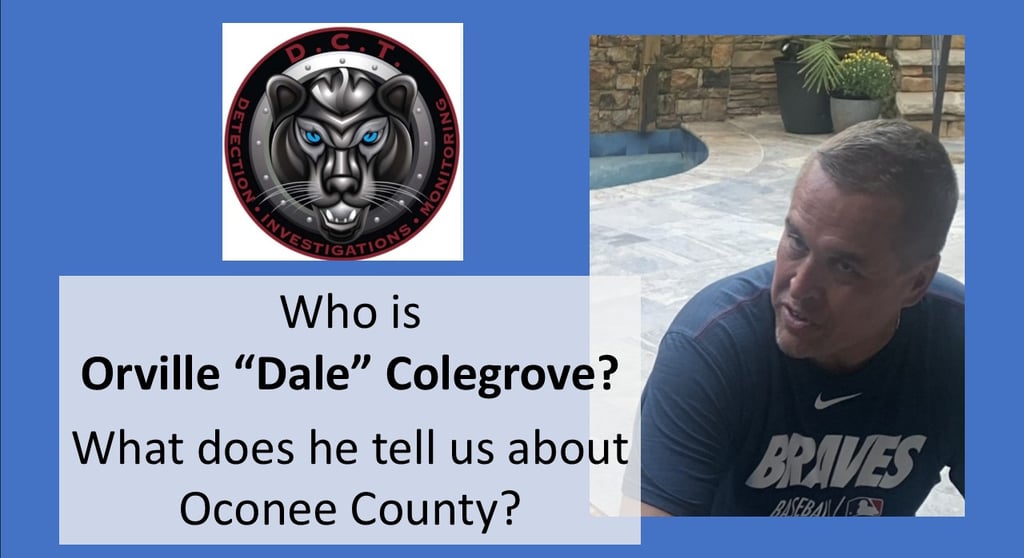
To understand the Preece Case we first have to establish: Who Is Dale Colegrove?
Before examining the allegations in Natasha Preece’s federal lawsuit, it is important to understand who Orville “Dale” Colegrove is—and to weigh his history within the larger context of how far Oconee County’s institutions appear willing to go to protect the connected and punish the inconvenient.
Readers familiar with Oconee News will understand the lengths that Oconee County will go through to protect their state actors such as Jason Alderman, former Sheriff James Singleton, Probate Judge Danny Singleton, informant Nick Blackwell, detective Jimmy Dixon and others. On the opposite side, it is clear that Oconee County will have no shame in persecuting those they deem a problems for the local power structure. Think: Jason Boyle (me), Dorothy Pierce (my wife), James Bartee, Jaime Mamian Motta and now, apparently, Colegrove’s own sister, Barbra Colegrove Marcum.
The cases are not identical, and association alone proves nothing. But the recurring question is unavoidable: Are Oconee County’s institutions applying the law impartially, or are they protecting insiders while using government authority against those who become a nuisances to the powers that be? Does the United States Constitution apply in Oconee County?
Dale Colegrove was not a peripheral figure in Oconee County law enforcement. Public court records identify him by the rank of sergeant with the Oconee County Sheriff’s Office, where he conducted Interstate 85 traffic enforcement and participated in major drug-interdiction investigations. Court opinions place him at the center of stops involving substantial cocaine seizures and lengthy prison sentences.
In the most prominent case, a traffic stop conducted by Colegrove led to Terry Tindall’s conviction for trafficking cocaine, a 25-year prison sentence and a $250,000 fine. In 2010, however, the South Carolina Supreme Court reversed the conviction, finding that the detention continued beyond the lawful purpose of the traffic stop without reasonable suspicion. The court ruled that the cocaine and Tindall’s statement should have been suppressed. Colegrove’s inappropriate methods also appeared in other search-and-seizure litigation. Many question now began answers, such as how he knew which cars had drugs in them. There are repeated rumors that it was his direct involvement in the drug trade that led him to know which cars to pull over and search.
After his public law-enforcement career, Colegrove remained deeply embedded in the local criminal-justice system. He and Tanya Colegrove became owners of DCT Detection, a private company that partnered with the Oconee County Sheriff’s Office to administer GPS ankle monitoring, alcohol monitoring and court-ordered drug-detection patches. DCT could monitor defendants, report alleged violations and trigger action that could return individuals to jail. DTC is directly involved in court proceedings that boost their own profits and keep the jails full, therefor supporting the revenue of the county. A symbiotic relationship that feeds off the flesh of the vulnerable in Oconee County.
I personally saw a representative from DCT testify on behalf of the 10th circuit solicitor against a purported violator. This is clear conflict of interest because the court ruling resulted in significant increased profits for DCT. Neither the Oconee County judicial system nor the solicitor at the time, Jason Alderman, found any problem with this arrangement. Why?
That documented influence is why the allegations surrounding Colegrove cannot simply be dismissed.
During Oconee News’ investigation of the county’s political and law-enforcement history, sources have repeatedly made allegations involving Colegrove, drug trafficking, protection of illegal activities by former Sheriff James Singleton and activities associated with a property known locally as “The Ranch.” The Ranch is told to be an event location in Oconee County used for gambling, prostitution, wild parties, orgies and blackmail. Some say the that Jerry Edwards, the owner and micromanager of the Seneca Journal, played a prominent role in the orchestration of the events at The Ranch. Some sources have described that property in terms invoking Jeffrey Epstein’s private network. Some say that John Towery, the Oconee County School Resource Deputy that was convicted of child trafficking, was suppling young girls to The Ranch. (See: https://www.oconeenews.org/dirty-cops-and-sacrificial-lambs-inside-oconee-countys-corrupt-system),
Sources have also alleged deep hostility between Colegrove and James Bartee, the former Secret Service agent who campaigned for Oconee County sheriff while promising to reform forfeiture for profit schemes and general corruption. This included a private detective report prepared by Colegrove that purportedly incriminated Bartee. Bartee was arrested in 2012 after informant Nick Blackwell recorded conversations concerning the proposed abduction of retired Circuit Court Judge James Williams, who was challenging Bartee’s eligibility to run for sheriff. It is important to note that Blackwell was under investigation for murder by the Oconee County Sheriff’s Office at the time of Bartee’s arrest. That is right: the primary informant used by the Tenth Circuit to incriminate Bartee was the same man then under investigation by Oconee County in connection with the murder of Michael “Mikey” Sane Barnes. It is difficult to deny the possibility that Bartee’s demands for transparency and accountability within the Oconee County Sheriff’s Office put a target on his back.
An Oconee County jury convicted Bartee of solicitation to commit a felony in 2013, and Circuit Judge R. Lawton McIntosh imposed a ten-year sentence suspended to five years in prison. The Court of Appeals affirmed the conviction in 2016, and Bartee was later pardoned. Bartee maintained that he had never solicited a kidnapping and accused Blackwell of manufacturing the case to prevent him from being elected and exposing forfeiture abuses and other corruption within Oconee County. I studied the case and was flabbergasted by many of its facts, particularly the claim that Bartee, a man of means, paid less than $200 to have a judge kidnapped from his home, driven to North Carolina, and then released. I listened to the recordings used in the prosecution and could not find anything resembling an incriminating statement. This is exactly the kind of hoax Oconee County is capable of constructing when protecting its illegal profits and shielding corruption.
This story would be difficult to believe if not for the history and reputation of Oconee County.
Preece alleges that a mother’s efforts to monitor the safety of her teenage son, who was spending time with Dale Colegrove, were transformed into a South Carolina harassment charge, an interstate arrest in Ohio, three days in jail and a continuing campaign of intimidation. She claims powerful private citizens in Oconee County used their relationships with Seneca police to turn public authority against her—and that police officers nearly 500 miles away agreed to carry it out.
The complaint is real, the arrest was real, and an Ohio judge later determined that Preece had not fled from South Carolina.
The case, Natasha L. Preece v. City of Westerville et al., was filed on January 21, 2025, in the United States District Court for the Southern District of Ohio. It is docketed as Case No. 2:25-cv-00050 and seeks damages under 42 U.S.C. § 1983, the federal civil-rights statute used when government officials are accused of violating constitutional rights while acting under color of state law.
The lawsuit names the cities of Westerville, Ohio, and Seneca, South Carolina, along with Westerville Police Chief Charles Chandler; Westerville officers Chris Davis, Jennifer Ahlborn, C. Jackson and Douglas Staysniak; Seneca Police Major Jeremy Rothell; Seneca dispatcher Jennifer Heller; five unidentified officers from the two departments; and Oconee County residents Orville “Dale” Colegrove and Tanya Colegrove.
Rothell, Heller and the named police officers are sued in both their official and individual capacities. The complaint alleges that Dale and Tanya Colegrove acted with government officials to deprive Preece of her constitutional rights.
The Arrest
After Preece’s teenage son left Ohio on October 28, 2023, she reported the circumstances to law enforcement and continued trying to determine whether he was safe. The following day, she alleges, Dale Colegrove attempted to persuade another of her sons to make false accusations against her. On November 28, 2023, after learning that her son was in Pigeon Forge, Tennessee, Preece requested another welfare check.
According to the lawsuit, Seneca Police Major Jeremy Rothell then pursued a South Carolina warrant accusing Preece of second-degree harassment. Seneca officials contacted the Westerville Division of Police and requested that officers in Ohio arrest her, while indicating that Seneca intended to seek full extradition.
On January 21, 2024, Westerville officers Chris Davis, Jennifer Ahlborn, C. Jackson and Douglas Staysniak, along with unidentified officers, arrested Preece in Ohio. She was taken to the Franklin County Correction Center II, commonly known as Jackson Pike, where she remained for approximately three days.
The complaint alleges that the Ohio officers had no lawful warrant or other legal authority to arrest her on the South Carolina misdemeanor charge. It further alleges that Seneca dispatcher Jennifer Heller sent a communication to the jail stating, “We will extradite.”
Preece was later released on a $10,000 recognizance bond and ordered to surrender herself or report to South Carolina. After an evidentiary hearing, Franklin County Common Pleas Judge Andrew Miller found that she had not fled from justice, canceled the arrest order issued against her, and terminated the extradition proceeding.
Allegations of childhood abuse
Preece lives in Franklin County, Ohio. Her complaint begins decades before the arrest at the center of the lawsuit.
She alleges that when she was approximately five or six years old, her uncle, Dale Colegrove, sexually molested her on several occasions in Lenore, West Virginia.
The complaint states that because of that alleged abuse, Preece generally avoided contact with Colegrove as an adult. Dale Colegrove has not been convicted of the alleged childhood assaults, and the federal complaint does not itself establish that they occurred.
Beginning in 2021, according to Preece, Dale and Tanya Colegrove began displaying what the complaint describes as a “disturbing amount of attention” toward her teenage sons.
Preece alleges the Colegroves invited the boys on vacations to Gatlinburg, took them to college football games and provided numerous gifts, including clothing, sunglasses, electronic devices, bedding, new iPhones and cash.
The lawsuit states that Preece was extremely uncomfortable with the attention and attempted to limit her sons’ contact with Dale and Tanya Colegrove.
Pressure for J.P. to move to South Carolina
By 2023, Preece alleges, Dale and Tanya Colegrove were encouraging one of her sons, identified in the complaint only as J.P., to leave Ohio and live with them in South Carolina during his senior year of high school.
The complaint also alleges that the Colegroves attempted to obtain a South Carolina driver’s license for J.P. that year.
According to the filing, J.P. left Preece’s home on October 28, 2023, withdrew from his Ohio high school and moved into Dale and Tanya Colegrove’s South Carolina residence.
The following day, October 29, 2023, Preece alleges that Dale Colegrove called another of her sons, identified as P.P., and attempted to persuade him to manufacture false accusations against his mother.
After that conversation, Preece contacted law enforcement in West Virginia and reported the sexual assaults she alleges occurred during her childhood. She also reported the circumstances of J.P.’s departure to the Westerville Division of Police.
The complaint states that Westerville officers were initially receptive to Preece’s concerns but abruptly abandoned their investigation after being contacted by Major Jeremy Rothell of the Seneca Police Department.
Preece alleges that Rothell was familiar and friendly with Dale and Tanya Colegrove and that the three conspired to intimidate and silence her about the alleged childhood abuse while preventing her from checking on J.P.’s safety.
When Preece contacted Seneca police to request a welfare check on her son, she alleges that Rothell told her the request would be documented as harassment.
A mother’s welfare check becomes alleged harassment
On November 28, 2023, according to the complaint, Preece learned that J.P. was in Pigeon Forge, Tennessee. She contacted law enforcement there and requested another welfare check.
This request then turns to South Carolina Arrest Warrant No. 2023A3710100272, January 3, 2024, allegedly obtained through a sworn affidavit prepared by Rothell.
Rothell’s affidavit accused Preece of harassment in the second degree under South Carolina Code § 16-3-1700(B). That offense is a misdemeanor punishable by no more than 30 days in jail and a fine of no more than $200.
South Carolina law defines second-degree harassment as a pattern of intentional, substantial and unreasonable intrusion into another person’s private life that serves no legitimate purpose and causes emotional distress.
Preece’s attorneys allege that the affidavit did not establish the elements of that offense. They further accuse Rothell of knowing that the assertions were insufficient and “patently false,” yet submitting them to harm, intimidate and silence Preece. Those are among the lawsuit’s most serious allegations.
The essential question is difficult to ignore: how did a mother’s efforts to learn whether her teenage son was safe become a criminal harassment allegation?
Seneca contacts Ohio
On or about January 4, 2024, the complaint alleges, Rothell—or an unidentified officer acting at his direction—contacted the Westerville Division of Police.
Preece alleges that Seneca officials notified Westerville of the South Carolina warrant, requested that Ohio officers arrest her and advised that Seneca intended to seek “full extradition.” The Seneca tax payers should be, if nothing else, concerned about the Seneca Polices willingness to spend tax dollars at the behest of Colegrove. Extradition is not cheap!
The lawsuit contends that the warrant did not authorize Ohio police to arrest Preece. It alleges that Rothell and the unidentified Seneca officer knew they were asking Westerville officers to act outside their lawful authority. This type of behavior is egregious, yes, and also par for the course in Oconee County when the power structure is threatened.
Preece also advances claims against both cities. She alleges that Westerville, Seneca and Chief Charles Chandler maintained policies, customs or training so inadequate that officers did not understand the legal requirements governing arrests on out-of-state warrants. Of course this is more than likely true, but what is also true is that Oconee County is indifferent to the law itself.
According to the complaint, Westerville officers then attempted to contact Preece and began surveilling her residence, as if she was a high value criminal target.
The filing alleges that the Westerville Police Department had 17 days to review the South Carolina warrant, determine what authority it provided and discover whether Ohio officers could lawfully execute it. Preece claims they failed to conduct that review—or, more than likely, just ignored its result.
Arrested in Ohio
On January 21, 2024, Westerville officers Chris Davis, Jennifer Ahlborn, C. Jackson and Douglas Staysniak, together with two unidentified officers, arrested Preece. The six-officer team was constructed to ensure that the fragile officers had the power necessary to handle the concerned mom. It is important for officer safety that in times like this, no expense was spared.
The complaint alleges that none of the officers possessed an Ohio warrant and that no legal basis existed for a warrantless arrest. This should be hard to believe, but this is 2026 in America.
After the arrest, Preece was taken to the Franklin County Correction Center II, commonly called Jackson Pike.
The lawsuit states that the Seneca Police Department then faxed a communication to the Franklin County jail. In that communication, Seneca dispatcher Jennifer Heller allegedly wrote:
“We will extradite.”
Preece’s attorneys accuse Seneca, Rothell and Heller of knowing that they lacked authority to extradite her from Ohio. Clearly someone in Seneca had their feeling hurt, and in Oconee county when feeling get hurt, the law is ignored. The complaint goes so far as to characterize the effort as an “unlawful kidnapping.”
Three days in jail
Preece remained in Jackson Pike for approximately three days.
On or about January 23, 2024, Franklin County Common Pleas Judge Bill Sperlazza released her on a $10,000 recognizance bond, meaning she was released without having to deposit that amount in cash.
The order required Preece either to surrender herself or personally report to South Carolina by February 6, 2024.
When Preece did not report to South Carolina by February 6, the Ohio court issued an arrest order on February 8, 2024.
But on February 13, 2024, after an evidentiary hearing, Franklin County Common Pleas Judge Andrew Miller found that Preece had not fled from justice in South Carolina. Judge Miller set aside the arrest order, and the Ohio proceeding was terminated.
WCMH reporter Ava Boldizar covered the lawsuit on January 28, 2025. WCMH reported that Preece had been held for three days, later released and ultimately had the Ohio proceeding dismissed. The City of Westerville told WCMH that it could not comment on pending litigation.
Allegations that the intimidation continued
Preece alleges that the arrest was not the end.
The complaint states that during the following year, unidentified Westerville officers repeatedly parked near her residence without a genuine law-enforcement purpose. She claims the police presence was intended to intimidate her into remaining silent about the arrest. Nothing like doubling down with taxpayer dollars.
Preece also alleges that Rothell made comments indicating he was tracking her location and referenced a trip she made to Kentucky. It is well known that although it is illegal for South Carolina law enforcement to put a GPS tracker on private cars, they use what they believe to be a loophole and hire private detectives, like Dale Colegrove, to place and track them. This part of this story makes good sense to those familiar with the tactics of Oconee County "law" enforcement. This would seems preposterous to the average American, until you realize that in Oconee County, the U.S. Constitution does not apply.
According to the lawsuit, these actions were intended to silence Preece regarding her alleged childhood abuse, prevent her from challenging the arrest and interfere with her efforts to communicate with or monitor J.P.
Preece contends that the cities of Westerville and Seneca, along with Chief Chandler, ignored, approved or ratified the officers’ conduct.
The Lawsuit
Preece’s lawsuit accuses the defendants of violating her First and Fourth Amendment rights through retaliation, false arrest, unreasonable seizure and malicious prosecution. She also brings state-law claims for conspiracy, assault and battery, invasion of privacy and intentional infliction of emotional distress. She seeks compensatory and punitive damages, attorney’s fees and a jury trial.
Preece is represented by Columbus attorneys Samuel H. Shamansky and Donald L. Regensburger.
The Preece lawsuit does not exist entirely in isolation.
On June 3, 2026, FITSNews journalist Jenn Wood published a separate report concerning a probate and civil dispute between Barbra Colegrove Marcum and her brother, Orville “Dale” Colegrove, arising from the treatment, death, cremation and estate of their mother, Pearl Colegrove.
According to FITSNews, Marcum’s March 2025 lawsuit accuses Dale Colegrove of improperly exercising authority under a power of attorney, restricting relatives’ access to Pearl during the final months of her life and repeatedly seeking additional morphine for her care. Marcum further alleges that Dale obtained a separate morphine prescription shortly before Pearl’s death and administered excessive morphine that contributed to her death. She has asserted wrongful-death and survival claims based on those allegations. Dale Colegrove has denied wrongdoing.
Marcum also alleges that Dale improperly authorized the cremation of Pearl, a widow, despite knowing that Pearl and her late husband had purchased burial plots and intended to be buried. Her lawsuit further accuses him of later selling their parents’ home for his own benefit. Mountain View Funerals and Cremations is also accused of proceeding with the cremation without proper authorization and while family members were attempting to obtain an autopsy.
The South Carolina Law Enforcement Division opened an investigation into Pearl Colegrove’s death in May 2023 after concerns were raised during the autopsy. FITSNews reported that investigators examined bruising, toxicology results, morphine administration records, medical documentation and the circumstances of Pearl’s hospice care. SLED formally closed the investigation on August 28, 2023, without filing criminal charges, citing insufficient evidence and an inability to determine how much morphine had actually been administered. Clearly, if SLED did a proper audit of the conduct in Oconee County, there is an abundance of evidence ranging from forfeiture profits, valuable evidence missing and coverups to protect state actors. The fact that SLED led the investigation and found insufficient evidence is unfortunately par for the course. This behavior form SLED, and the court system, is the reason that Oconee remains a lawless land.
The dispute also concerns control of Pearl’s estate. Dale Colegrove was appointed personal representative under the succession provisions of Pearl’s will. Marcum argues that he has an unavoidable conflict of interest because he controls the estate while simultaneously defending himself against claims the estate might have the authority to pursue. She has therefore sought appointment of an independent special administrator to evaluate and potentially bring those claims on behalf of the estate.
FITSNews also reported that Oconee County Probate Judge Danny Singleton recused himself after acknowledging that he had worked with Dale Colegrove at a police department for approximately two years more than three decades earlier. The probate matter was later assigned to Associate Probate Judge Griselda Godoy, who ruled that Dale should serve as personal representative under the terms of the will. Here again, from the well known history of Danny Singleton's probate court, it is hard to imagine there was an impartial judgement based on the merits of the evidence. Related proceedings concerning the proposed appointment of a special administrator were placed before Circuit Judge R. Scott Sprouse, another judge with a multitude of complaints alleging his lack of concern for the law.
When will this stop?
Whether Natasha Preece ultimately proves every allegation is for a federal court—and perhaps a jury—to decide. But the public does not need a verdict before asking the obvious question: What in the world is happening here?
A mother tried to determine whether her teenage son was safe. She requested welfare checks. In response, she was accused in South Carolina of a misdemeanor carrying no more than 30 days in jail and a $200 fine. Then officers in Ohio—six of them, according to the complaint—watched her home, arrested her without an Ohio warrant, carried her to jail and held her for three days because Seneca officials announced that they intended to extradite her.
The complaint alleges that they had no lawful authority to do it.
That is not a paperwork error. That required participation. It required phone calls, records, surveillance, officers, jail personnel and officials in two states. It required people with badges and titles to look at a South Carolina misdemeanor allegation and decide that a mother in Ohio should lose her freedom.
Dale Colegrove appears to have powerful friends—and very thin skin.
In my own interactions with Seneca Police Chief Casey Bowling, I have seen no meaningful appetite for confronting misconduct when doing so would require standing against the local establishment. In fact, he will lay down a thick smoke screen to protect “friends” of the system against justice. This is what happens when officials learn that the public will not challenge them, institutions will protect them and citizens will leave one another to face government power alone. OconeeNews.org is here because I cannot sit and watch any longer. The people should not be pawns to be sacrificed at the whims of the county’s needs.
Oconee County’s players allegedly wanted Natasha Preece arrested. That is disturbing enough.
The greater indictment is that officers in Ohio may have agreed to help them.
How many people examined the warrant and remained silent? Preece is not accused of stalking, threatening or interfering. She is accused of calling the police to report crimes and request verification of the well being of her son. Even if this could be construed as a crime, how many understood that it involved a minor South Carolina charge that in no way justified extradition or an interstate arrest warrant but continued anyway? Why did no one stop the machinery during the 17 days Westerville officers had to review the matter? Who decided that Seneca’s demand was more important than an Ohio citizen’s constitutional rights?
This was not an accident. It was government power moving across state lines to punish a woman who would not stop asking questions.
And when authority can travel from Oconee County to Ohio, surround a home, seize a mother and place her behind bars over a misdemeanor allegation, the question is no longer merely what has happened to Oconee County.
The question is: What is happening to the nation?
Oconee News © 2024
Oconee News is dedicated to exposing corruption within the local law enforcement agencies and judicial system.
Contact us: Info@OconeeNews.orgtataverCtical
Reframe your inbox
Subscribe to our newsletter and never miss a story.
We care about your data in our privacy policy.